





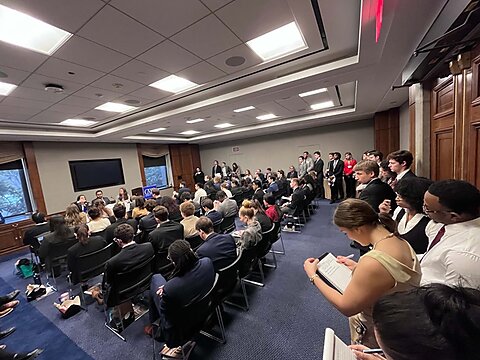

Last week on Capitol Hill, we discussed a risk that is becoming more real every day that Congress delays fixing the debt: fiscal dominance—when rising federal debt pushes the Federal Reserve to prioritize financing government spending over controlling inflation.
The Congressional Budget Office now projects that over the next 10 years, the United States will borrow an additional $25 trillion. About $16 trillion of that will go toward interest payments alone. By 2036, interest costs, Social Security, Medicare, and Medicaid are projected to consume 100 percent of federal revenues.
Read that again.
Under current law, within a decade, every dollar collected in revenue will go toward autopilot entitlements and debt service, leaving nothing for national defense or any other core function of government. See Figure 1 if you, too, need to see it to believe it.
Debt is no longer a long-term problem. When interest costs surpass what the US government spends on national defense, while reaching debt levels not seen since World War II and growing indefinitely from there, we need to confront the ugly truth: We have a debt crisis right now. The United States still benefits from deep capital markets and dollar dominance. And markets respond to political signals on a forward-looking basis, not just current debt levels.
The Coming Fiscal Inflection Point
A fiscal inflection point occurs when markets lose confidence that lawmakers will stabilize the debt. When that happens, the reaction can be swift: rising yields, a flight from treasuries, and inflation driven as much by anticipation as by action—outcomes seen many times in other countries with unsustainable social spending, including the United Kingdom, Argentina, Brazil, Ecuador, and Turkey. In extreme cases, countries have lost their currencies to hyperinflation because of fiscal profligacy combined with central bank accommodation.
I witnessed the aftermath of the German inflation trauma at home. My German grandmother used to advise us to buy tangible assets before fiat currency could be destroyed. She had a picture frame with samples of high-denomination Reichsmark hanging in her living room, serving as a constant reminder of Germany’s past hyperinflation and the need to take precautions.
Despite running chronic peacetime deficits of roughly 6 percent of gross domestic product (GDP), the United States still benefits from a safe-asset premium. Investors may assume that Congress will eventually act.
The next stress test is approaching quickly: Social Security and Medicare Part A trust fund depletion around 2032. At that point, Social Security and Medicare hospital insurance benefits will be automatically cut, unless Congress intervenes. Allowing default benefit reductions to kick in appears politically unlikely. Lawmakers will face another choice: implement structural reforms to restore fiscal sustainability or borrow even more to avoid politically difficult benefit and tax changes.
Markets will be watching, Veronique De Rugy warned us. Debt must be backed by a credible plan for repayment. Without that fiscal backing, the inflation risk compounds. Should Congress decide to keep borrowing to fund Social Security and Medicare, without serious reforms to address their structural imbalances, bondholders may declare game over. Social Security, Medicare, and Medicaid are the largest and fastest-growing components of the federal budget. Their trajectory, not discretionary spending, despite Congress dedicating outsized attention to arguing over a shrinking share of the budget, determines whether the debt stabilizes or spirals.
How Congress handles trust fund depletion will signal whether lawmakers are serious about reform or intent on allowing the unsustainable fiscal trajectory to deteriorate until bond markets force their hand.
Affordability Is Driven in Part by Fiscal Sustainability
This isn’t just about bond markets tomorrow. It’s also about affordability today. Elevated interest rates already reflect growing concern about America’s fiscal path.
Constituents are feeling higher prices in housing, groceries, energy, and health care. When persistent deficit spending subsidizes demand without addressing supply constraints, this pushes prices higher.
You cannot spend your way to affordability. You can spend your way into a debt crisis that eventually results in higher prices.
The Fed Can’t Fix Congress’s Entitlement Spending Problem
Jai Kedia underscored a critical point: The Federal Reserve’s job is to maintain price stability, not to finance federal deficits.
Fed independence means monetary policy is guided by economic conditions, not by the Treasury’s borrowing needs. Once that line blurs, inflation becomes harder to control.
In a fiscal crisis, the Fed can lower interest rates or expand its balance sheet to provide liquidity to markets. But leveraging those tools for the wrong reasons entails negative consequences.
Lower rates reduce federal interest costs in the short run, but if deficits remain high, they risk fueling inflation. Quantitative easing can expand the money supply, while paying interest on reserves can avoid inflation, at least temporarily. Yet such balance sheet manipulation also gives Congress a backdoor spending mechanism that can bypass proper appropriations and postpone spending reforms until higher inflation becomes unavoidable. Over time, monetary policy begins bending toward accommodating fiscal excess. Should a fiscal crisis materialize, the Fed may find it difficult not to intervene and bail out the US Treasury.
That is what’s called fiscal dominance and its risks are rising.
We have seen versions of this play out abroad. When governments pressure central banks to suppress rates amid fiscal strain, inflation often follows—and restoring credibility later requires more painful tightening.
President Trump has called on the Fed to cut rates to reduce federal interest payments. That may provide temporary relief. But it does not solve the government overspending problem. Instead, it eventually shifts that cost into higher prices.
And inflation is even more economically damaging than reducing spending or increasing taxes because it distorts economy-wide prices, hurting economic growth.
Shrinking the Fed’s balance sheet would reinforce the message that the central bank is not a permanent buyer of government debt. Markets need to believe that government spending will be sustainably financed without resorting to dollar debasement. When that belief topples, higher interest rates, a flight from treasuries, and inflation will follow.
What Congressional Staff Should Take Back to Their Offices
It’s not too late to avoid harmful inflation from fiscal recklessness, but the clock is ticking. Congress should:
1. Reform the unsustainable entitlement programs. Social Security and Medicare depletion could be the next fiscal inflection points. Congress should advance bipartisan reform proposals now—before markets impose borrowing discipline.
2. Insist on fiscal backing. Don’t add to deficits and debt, and adopt a credible fiscal framework that stabilizes spending and the debt by aligning federal spending with what the US economy and historical revenues can support. A three percent of GDP deficit target, as proposed by Bipartisan Fiscal Forum cochairs Representatives Bill Huizenga (R‑MI) and Scott Peters (D‑CA), along with forum members Representatives Lloyd Smucker (R‑PA) and Mike Quigley (D‑IL), is a good place to start.
3. Protect Fed independence. Monetary policy should not subsidize fiscal shortfalls. Congress should mandate the Fed to reduce its balance sheet and conduct rules-based monetary policy.
4. Leverage reconciliation to reduce deficits. Congress should reduce excess health care spending, streamline taxes, and cut welfare programs prone to fraud and abuse.
5. Advance an effective fiscal commission. A Base Realignment and Closure–style fiscal commission could help overcome political inertia and provide Congress with political cover to advance necessary entitlement reforms. The Fiscal Commission Act, championed by Representatives Scott Peters (D‑CA) and Bill Huizenga (R‑MI) alongside a growing roster of bipartisan cosponsors, is a promising step in that direction.
A Better Path
Fiscal dominance is not inevitable; it’s a policy choice. Congress should begin stabilizing the growth in US debt by committing to a clear, enforceable fiscal anchor. The Bipartisan Fiscal Forum’s proposed deficit target of no more than three percent of GDP would provide a meaningful benchmark to slow debt growth and ease upward pressure on interest rates. Pairing that target with a BRAC-style fiscal commission would give lawmakers the procedural structure and political cover needed to advance entitlement reforms that are economically necessary but politically insurmountable.
More immediately, Congress could pursue a second reconciliation bill to reduce deficits now by reforming federal health care programs that are driving long-term spending growth and by reining in federal welfare programs that are prone to fraud and abuse.
While there is no painless exit from the unsustainable budget trajectory, further delay makes the necessary adjustments only harsher and the available choices narrower.
Inflation isn’t a fix; it’s fiscal failure. Without serious spending restraint through health care and Social Security reform, dollar debasement becomes the default path of least political resistance. Let’s not let it come to that.
Additional resources:
- The Threat of Fiscal Dominance: Will the US Resort to Money Printing to Finance the Rising Debt Challenge?
- How Government Debt Raises Your Borrowing Costs and Makes Life Unaffordable
- The Debt Delusion: Why Modern Monetary Theory Is a Luxury Belief
- Reforming the Federal Reserve, Section 5: Preventing Fiscal Dominance
- When Trust Funds Run Dry: The Price Level May Do the Adjusting if Congress Doesn’t
- Trump Is Not the Biggest Threat to the Fed’s Independence
- Fiscal Dominance: How Worried Should We Be?