






Republicans are preparing to spend up to $140 billion on immigration enforcement through reconciliation. Leadership claims that offsets are not needed because new appropriations are “never” paid for. That claim is false, and deficit hawks who accept it weaken their own hand in every future fight.
Here are four reasons Congress should reject any reconciliation package that does not include at least $133 billion in offsetting spending cuts:
1. $140 Billion Blows Past the Spending Targets Congress Already Set
In the Fiscal Responsibility Act of 2023, Congress agreed to a discretionary spending target of $1.62 trillion for FY2026. That’s about $47 billion above the currently enacted $1.57 trillion base discretionary budget. The interim 302(b) allocations for FY2026 similarly adhere to a discretionary topline of $1.6 trillion, with Homeland Security receiving $66 billion.
The Senate Budget Committee’s new budget resolution authorizes $140 billion in new deficit spending, split into two separate $70 billion deficit-increasing instructions for the Judiciary and Homeland Security committees. That is double the previously floated $70 billion price tag. Importantly, the resolution includes no offsetting requirements and waives PAYGO—a clear signal that Senate leadership has no intention of being fiscally responsible.
A non-offset $140 billion reconciliation package would blow past both the Fiscal Responsibility Act target and the interim 302(b) allocations. That’s before considering that Congress is likely to spend billions more to backfill other shutdown-affected Department of Homeland Security (DHS) agencies, such as the Coast Guard, TSA, and FEMA. For context, the FY2025 DHS discretionary budget was $126 billion. Excluding ICE and Border Patrol, it was $96 billion.
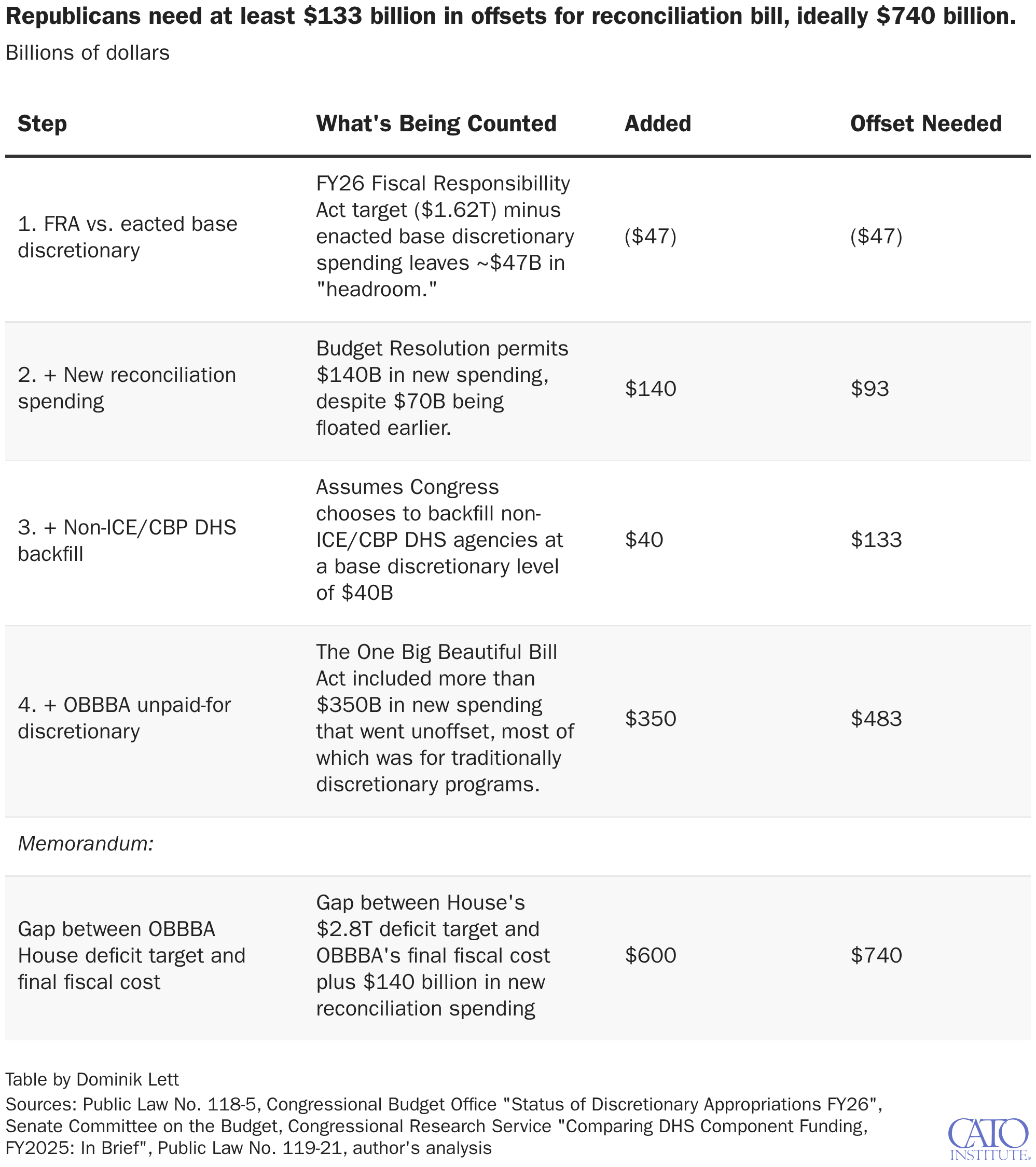
At a minimum, Republicans need at least $133 billion in offsets to stay within their own agreed-upon targets, and closer to $740 billion to undo the fiscal damage of recent reconciliation (see the appendix for a table and full accounting).
When Congress decides to spend more than the levels it has already agreed to, offsets are necessary. Budget deals like the Bipartisan Budget Acts of 2013 and 2015 and the Fiscal Responsibility Act of 2023 all follow this kind of logic. In exchange for a debt limit extension, Congress agreed to topline spending levels, created spending caps to enforce those levels, and adjusted discretionary spending accordingly, including by offsetting new appropriations that would exceed caps.
The main difference between today and then is that Congress is not facing a debt limit expiration, and the Fiscal Responsibility Act’s spending targets are nonbinding. Neither fact is a reason to pretend Congress has “never” paid for appropriations or to justify fiscal irresponsibility.
2. $140 Billion for ICE and Border Patrol is Not Comparable to Routine Spending
If the argument is that reconciliation should be compared to normal appropriations, then we ought to compare the proposed spending package to normal agency budgets. In FY2025, ICE’s discretionary budget was about $10 billion, and Border Patrol’s budget was around $20 billion. A $140 billion package is nearly quintuple their combined budget, hardly a routine increase.
Even this comparison is charitable, though, given that it does not include the nearly $140 billion in extra money Congress already provided for ICE and Border Patrol through the One Big Beautiful Bill Act.
If you add up the $140 billion being floated for DHS, the $190 billion in DHS-related One Big Beautiful Bill Act resources, and the usual discretionary spending, Republicans are poised to triple the DHS budget.
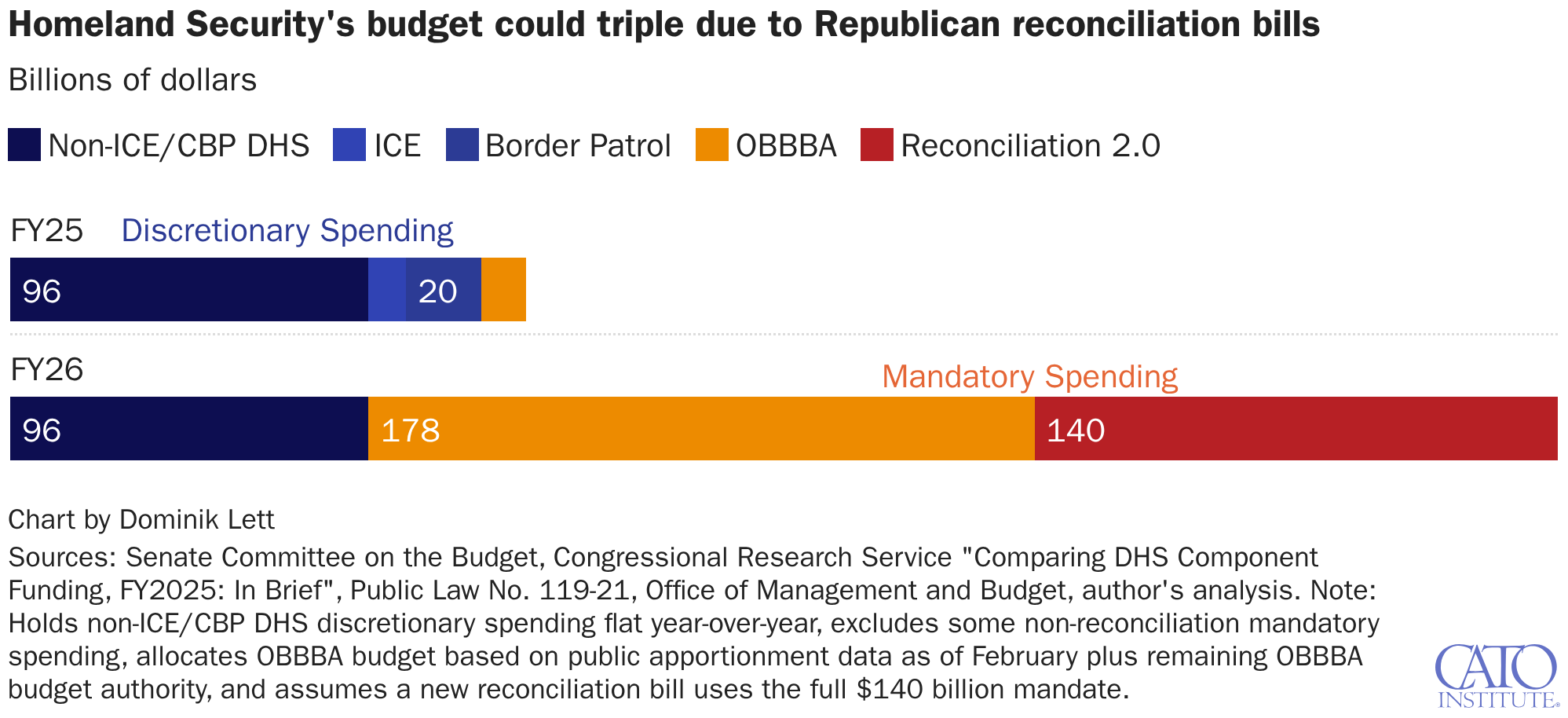
This estimate comes with some caveats. It holds non-ICE/Border Patrol spending flat and front-loads reconciliation costs. But even if you spread the reconciliation money more evenly over the next few years, the DHS budget would still far exceed the typical discretionary budget.
3. Reconciliation Was Designed for Deficit Reduction
Unlike normal appropriations bills, reconciliation bypasses the filibuster, requiring only a simple majority in both chambers. It was designed this way, in part, to fast-track deficit reduction. Deficit-reducing policies tend to be less politically popular than deficit-increasing ones, so reconciliation was created as a tool to help align spending and revenue with budget targets.
Congress has stretched reconciliation well beyond that purpose. Under Biden, Democrats used it to fund stimulus checks, the IRS, and green energy subsidies. Under Trump, Republicans have used it to boost defense and immigration enforcement spending.
Every deficit-increasing use of reconciliation makes the next one easier to justify. The next Democratic majority isn’t likely to forget either.
4. $2 Trillion Annual Deficits Demand Offsetting Everything
The federal government is running a $2 trillion annual deficit. In 2026, publicly held federal debt will exceed the nation’s entire annual economic output for the first time since World War II. Congress is spending more on interest payments than on the entire discretionary defense budget. This fiscal situation is already dire and will continue to worsen, driven primarily by automatic spending on Medicare and Social Security.
A $140 billion spending increase in 2026 will deepen debt, generating roughly $60 billion in new interest costs over 11 years. And the bill’s final cost could far exceed what is advertised due to logrolling. The One Big Beautiful Bill Act, for example, ballooned $600 billion in size compared to the House’s original $2.8 trillion deficit target.
There is no shortage of budget offsets deficit hawks can demand to prevent a similar outcome. Eliminating the SNAP categorical eligibility loophole, ending Medicaid financing scams, and cutting Medicare Advantage overpayments, for example, would save more than $1.1 trillion over 10 years.
Accept This Argument and Weaken Your Hand
Any Republican who accepts the “no offsets needed” argument should expect the next Democratic majority to copy the Republican playbook without apology. Why should Democrats’ priorities require pay-fors if Republicans’ priorities don’t?
Deficit hawks should demand offsets.
Appendix:
Since Republicans intend to use reconciliation to replace discretionary spending, the package should be measured against discretionary targets Republicans have already agreed to. The Fiscal Responsibility Act and interim 302(b)s both set a top line of around $1.6 trillion. Using the more generous FRA target leaves $47 billion in headroom for new spending.
The $140 billion in new deficits allowed by the budget resolution far exceeds the available discretionary headroom, requiring at least $93 billion in offsets. Add in the around $40 billion in base discretionary spending Congress will likely backfill for non-ICE/CBP DHS agencies, and the needed offsets rise to $133 billion. Accounting for the more than $350 billion in non-offset discretionary related spending from the One Big Beautiful Bill Act pushes the offsets needed to $483 billion. And if deficit hawks want to make up for the full fiscal cost of OBBBA’s overrun—the $600 billion gap between the House’s $2.8 trillion deficit target and the bill’s final cost—the offsets needed climb to roughly $740 billion.