






On April 29, in Louisiana v. Callais, the Supreme Court examined what might be characterized as reverse gerrymandering. Four years earlier, in 2022, a federal judge ordered the state to redraw its congressional map to create a second majority-Black district. Previously, only one of six districts was majority-Black, even though 33 percent of the population was Black. After the legislature complied, non-Black voters claimed reverse discrimination. In response, the state insisted that the redistricting process was driven by partisan, not racial, goals—to preserve the seats of Speaker Mike Johnson and Steve Scalise.
Ordinarily, because it’s difficult to establish equitable standards for redistricting, courts do not intervene if the goals are partisan rather than racial. In Rucho v. Common Cause (2019), the Court decided that it would defer to the political process in resolving partisan disputes. But racial motives are barred by the 1965 Voting Rights Act (VRA), the 15th Amendment, and the 14th Amendment’s Equal Protection Clause.
Prior to Callais, here was the framework: Section 2 of the VRA banned discrimination in voting based on race, color, or language-unique ethnicity. In Shelby County v. Holder (2013), the Court struck down the pre-clearance formula in Section 4 as outdated, but Section 2 remained in effect. The applicable rules for Section 2 were established in Thornburg v. Gingles (1986). Majority-minority districts were OK under Section 2 as long as minority populations were: (1) sufficiently large and compact to constitute a majority within a district; (2) politically cohesive (i.e., they vote similarly); and (3) unrepresented due to bloc voting by the racial majority. If those three conditions were met, the Court then looked to the “totality of the circumstances.”
Additionally, said the Gingles Court, it was not necessary to prove intentional discrimination; discriminatory impact was sufficient. Later, in Allen v. Milligan (2023), the Court affirmed Gingles and rejected Alabama’s argument that majority-minority districts must be drawn in a strictly race-neutral way—e.g., using algorithms that ignore race. The Court specified, however, that race may not be the predominant factor. This term, in Callais, the Court has materially refined Gingles.
The Court could have gone in several directions. First, the Court could have declared that the 1965 VRA is unconstitutional—either because the 14th and 15th Amendments do not permit race-based remedies or because conditions have changed and the VRA is no longer effective or even necessary. That outcome would have overturned 60 years of Supreme Court jurisprudence. Second, the Court could have decided that Louisiana’s motives were permissibly partisan, not racial, in which case the state would have prevailed. Instead, the Court pursued a third option—modifying the Gingles framework that governs Section 2 violations.
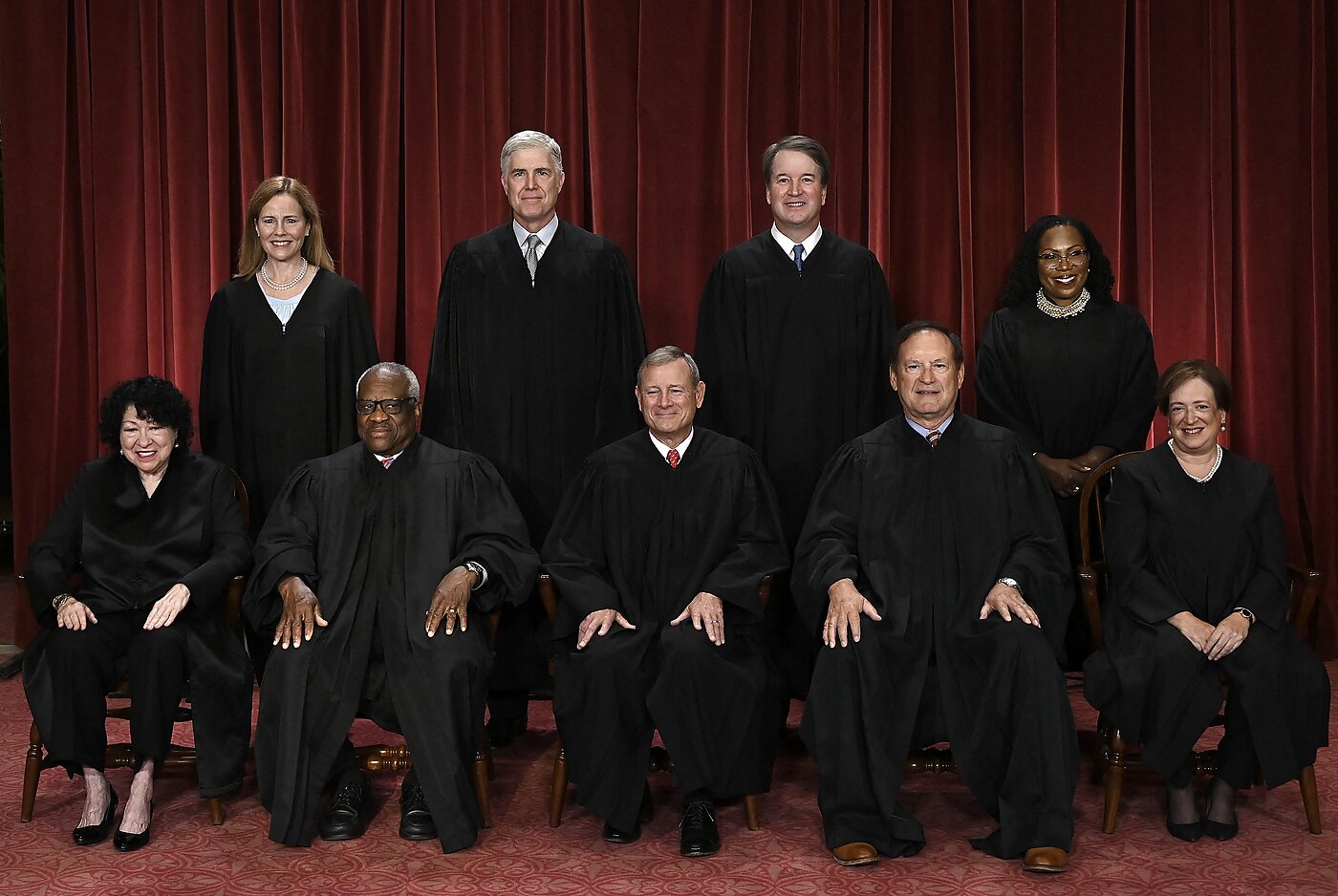
In Callais, Justice Alito, for a 6–3 ideologically divided Court, held that Louisiana unlawfully discriminated by race when it followed a lower court order to create a second majority-Black congressional district. Alito agreed that the VRA’s objective is to ensure that Blacks do not have less opportunity, because of race, than others to elect representatives of their choice. But properly construed, he argued, “opportunity” must adjust for nonracial variables—e.g., political party and other allowable districting criteria. For example, if most voters in a district prefer Democrats, a Republican voter would have less opportunity—although not for racial reasons. Most importantly, he noted, the 15th Amendment is triggered by intentional racial discrimination, not merely disparate impact.
The Gingles framework, wrote Alito, should be updated to account for four factors: First, there have been great strides in ending entrenched racial discrimination. Second, we now have a full-blown two-party system, including in the South, and there’s substantial overlap between race and party preference. Third, Rucho’s rejection of federal court intervention in partisan gerrymanders has incentivized challengers to recharacterize partisan motives as if they were racial. Fourth, computer-drawn maps now enable greater racial balance while meeting legitimate redistricting goals.
As a result, the Court established three new rules, purportedly modifying (but essentially replacing) Gingles: (1) Race ordinarily cannot be used as a districting criterion, and maps must meet legitimate districting goals, including political goals. (2) Plaintiffs must show that racial bloc voting is not explained by party affiliation. (3) In assessing the “totality of circumstances,” the focus must be on current, intentional discrimination—not just ongoing disparities that are supposedly the “effects of societal discrimination.”
Because Louisiana’s underlying goal (directed by the lower court) was racial balancing, the mapping process triggered strict scrutiny. And because the state didn’t meet the three criteria outlined above, the new map could not survive rigorous review. No doubt, there will be political repercussions for the 2028 elections and even for the 2026 midterms, with gerrymandering disputes underway in Texas, California, Virginia, Florida, and other states—especially those that haven’t yet closed their ballots or started early voting.
As a legal and constitutional matter, the Court’s new approach may be correct in light of textual provisions, progress in race relations, and the difficulty in disentangling racial and partisan motives. But practical policy concerns, as well as reasonable legal arguments, also support Justice Kagan’s dissent, joined by Justices Jackson and Sotomayor. Kagan wrote, “Under the Court’s new view of Section 2, a State can, without legal consequence, systematically dilute minority citizens’ voting power.”
Presumably, the equitable goal from a political perspective is to move closer to proportional representation, where the percentage of Republican versus Democratic districts approximates the percentage of the population that votes for each party. Paradoxically, under the current district-by-district voting system, race-neutral criteria are highly unlikely to yield proportional results. Imagine a state with a 60–40 voter mix favoring Republicans. Imagine further that there’s no partisan or racial gerrymandering, with voters allocated randomly to, say, 10 districts. Under those circumstances, every district would be roughly 60 percent Republican and 40 percent Democratic. Assuming that voters support their party’s candidate, Republicans would win in all 10 districts. In other words, Democrats would get 40 percent of the vote and yet have zero representation in Congress. That’s what would happen with purely random allocations.
One way to avoid that outcome is to draw boundaries such that Democratic voters are the majority in closer to 40 percent of the districts. Accordingly, if the objective is proportional representation, partisan gerrymandering can be a feature, not a bug. And yet, in the Rucho case, the Supreme Court bowed out on the ground that complying with the constitutional mandate in Article IV, Section 4, for “a Republican Form of Government” raised a “political question.” Maybe Rucho should be overturned. Or, preemptively, Congress could follow Justice Alito’s counsel and exercise its lawmaking authority. One such initiative would be to bar mid-Census redistricting, which has fueled much of the recent controversy.
Currently, a dozen states use bipartisan, independent commissions that have either final or advisory responsibility for redistricting. They reportedly apply race-neutral factors such as equal population, compact shape, common interests of residents, and physical boundaries (such as rivers), as well as political boundaries (such as city and county lines). Those commissions might be a step toward equitable redistricting—although independence is difficult to ensure, and bipartisanship can be abused to stifle third parties and protect incumbents.
It seems clear that problems created by the current system of district-by-district voting cannot be resolved at the ballot box when the voting process itself is the source of the problem. Notably, however, the Constitution doesn’t require district-by-district elections. Article I, Section 2, simply states that representatives shall be “chosen every second Year by the People of the several States.” The manner of election is up to each state, subject to congressional override. A 1967 federal law (2 U.S.C. 2c) dictates that each state is to elect its representatives from single-member districts. But that’s a statutory requirement, not a constitutional one.
Perhaps the ultimate solution to the gerrymandering issue lies in a congressionally prescribed voting regimen that incorporates multi-member districts, at-large candidates, or outcomes that are proportional to party affiliation. To be sure, those options raise additional problems—a topic for another day.